34ºc, Sunny

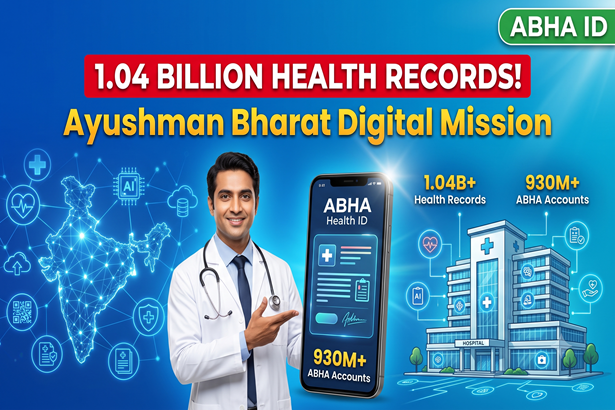
India's healthcare sector is undergoing a historic digital transformation through the Ayushman Bharat Digital Mission (ABDM), one of the world's largest digital public health initiatives. Launched by the Government of India in September 2021, the mission aims to create a unified, secure, and citizen-centric digital healthcare ecosystem that enables seamless access to medical services across the country.
According to the latest official data, more than 1.04 billion digital health records have now been linked with over 930 million ABHA (Ayushman Bharat Health Account) IDs, marking a major milestone in India's journey toward paperless and connected healthcare.
What Is the Ayushman Bharat Digital Mission?
The Ayushman Bharat Digital Mission is designed to simplify healthcare delivery by digitally connecting patients, hospitals, doctors, laboratories, pharmacies, insurance providers, and government health programs through a secure digital platform.
The mission allows citizens to create a unique 14-digit ABHA ID, which securely stores and links their medical history with their consent. This enables healthcare providers to access previous medical records instantly, reducing paperwork, duplicate tests, and treatment delays.
Key Features of ABDM
The digital health ecosystem offers several important services, including:
- Creation of secure ABHA Health IDs.
- Digital storage and sharing of medical records.
- Online appointment booking.
- Scan-and-Register facility using QR codes.
- Digital prescriptions and laboratory reports.
- Teleconsultation services.
- Health Facility Registry (HFR).
- Healthcare Professionals Registry (HPR).
- Unified Health Interface (UHI) for digital healthcare services.
- National Health Claims Exchange (NHCX) for faster insurance claim settlements.
Aarogya Setu 2.0 Introduced
The Government has also launched Aarogya Setu 2.0 as a comprehensive digital healthcare application under ABDM. Beyond its original COVID-19 role, the upgraded platform now provides:
- Health record management.
- AI-powered health insights.
- Appointment booking.
- Blood bank search.
- Digital insurance information.
- Emergency healthcare support.
- Smart medical report scanning using OCR technology.
Faster Hospital Registration
One of the biggest achievements of ABDM is the Scan-and-Share service.
Patients can simply scan a QR code at participating hospitals using their ABHA-linked mobile application. Their demographic details are securely fetched, allowing them to register within minutes.
Research conducted by the Indian Institute of Health Management Research (IIHMR) found that this digital system has reduced outpatient registration waiting time from nearly one hour to just 2–5 minutes.
Benefits for Patients
The mission offers several advantages for citizens:
- Paperless healthcare services.
- Secure digital medical records.
- Faster hospital registration.
- Easy access to healthcare anywhere in India.
- Better coordination among healthcare providers.
- Simplified insurance claims.
- Reduced duplication of medical tests.
- Greater transparency and patient control over health information.
Benefits for Healthcare Providers
Hospitals, clinics, laboratories, pharmacies, and doctors can register under the ABDM ecosystem and receive incentives through the Digital Health Incentive Scheme (DHIS).
Healthcare facilities also benefit from:
- Improved patient management.
- Streamlined digital workflows.
- Secure health data exchange.
- Easier insurance claim processing.
- Better administrative efficiency.
AI and the Future of Digital Healthcare
ABDM is also laying the foundation for India's healthcare AI ecosystem.
Using privacy-protected and consent-based health data, the government aims to strengthen disease surveillance, medical research, healthcare planning, and AI-powered diagnostics. Initiatives such as SAHI (Strategy for AI in Healthcare India) and BODH (Benchmarking Open Data Hub) are expected to accelerate responsible AI innovation while maintaining patient privacy and security.
Privacy and Data Security
Patient privacy remains a core principle of the mission.
Medical records are not stored in a centralized government database. Instead, data remains with the originating healthcare provider and can only be shared after receiving explicit patient consent. Every application integrating with ABDM must undergo security audits and compliance testing before joining the ecosystem.
A Major Step Toward Universal Digital Healthcare
With over 1.04 billion linked health records and 930 million+ ABHA accounts, the Ayushman Bharat Digital Mission has become one of the world's largest digital healthcare infrastructures.
The initiative is significantly reducing paperwork, improving healthcare accessibility, accelerating insurance claim settlements, and enabling secure digital health services across India. As the network continues to expand, ABDM is expected to play a transformative role in building a more efficient, connected, and technology-driven healthcare system for every Indian citizen.