34ºc, Sunny

In a remarkable scientific breakthrough, open-cast coal mines in Jharkhand have revealed evidence of a long-lost ecosystem that existed nearly 290 million years ago—long before humans or even dinosaurs walked the Earth.
The findings, based on fossil and geochemical evidence from the Ashoka coal mine in the North Karanpura Basin, provide fresh insights into dense swamp forests and river systems that once flourished when India was part of the southern supercontinent Gondwanaland.
Reconstructing a Prehistoric World
The study reconstructs an ancient Gondwana environment that was occasionally influenced by marine incursions. It sheds light on how rising sea levels—triggered by climatic shifts—may have reshaped continental landscapes during the Permian period.
Earlier studies had proposed multiple theories regarding marine transgression pathways based on fossil and sedimentary evidence collected from coalfields across India. However, the subject has remained controversial due to limited and scattered documentation of Permian marine flooding events.
Multidisciplinary Evidence from Jharkhand
The new research was led by the Birbal Sahni Institute of Palaeosciences (BSIP), an autonomous institute under the Department of Science and Technology (DST). Scientists collected paleobotanical and geochemical evidence from the Ashoka coal mine, uncovering exceptionally preserved fossil records of ancient plant life.
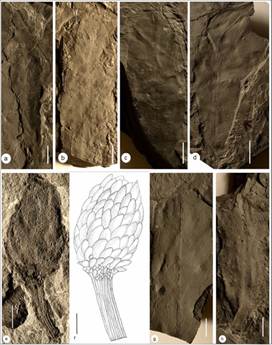
Among the most significant discoveries was the abundance of Glossopteris, an extinct group of seed-bearing plants that once dominated the southern continents. At least 14 different species of Glossopteris and related forms were identified in shale layers, preserved as delicate leaf impressions, roots, spores, and pollen grains.
A particularly notable discovery was the first juvenile male cone of Glossopteris found in the Damodar Basin—considered a globally important finding that may help scientists better understand the evolution of these ancient trees.
Chemical Clues of Ancient Seawater
Microscopic analysis of coal and shale samples revealed the presence of framboidal pyrite—raspberry-shaped mineral clusters—and unusually high sulfur content. These features indicate saline water conditions, which are uncommon in coal-bearing basins of this type and suggest marine incursions into the region.
Further chemical analysis of organic molecules using Gas Chromatography-Mass Spectrometry (GC-MS) suggests that marine organisms may have entered the Damodar Basin approximately 280–290 million years ago. The findings point to a Permian sea pathway advancing from northeast India toward central India.
Published Findings and Modern Implications
The study has been published in the International Journal of Coal Geology and provides valuable insights into the sedimentation history of the coal-bearing sequence in the North Karanpura coalfield.
📄 Read the full research publication here:
https://doi.org/10.1016/j.coal.2025.104860
By drawing parallels between ancient marine transgressions and present-day sea-level rise linked to polar ice melt, the study also offers important perspectives on how future climate change may reshape continental environments.
This discovery not only deepens our understanding of Earth’s geological past but also provides crucial lessons for interpreting ongoing global climate transformations.