34ºc, Sunny

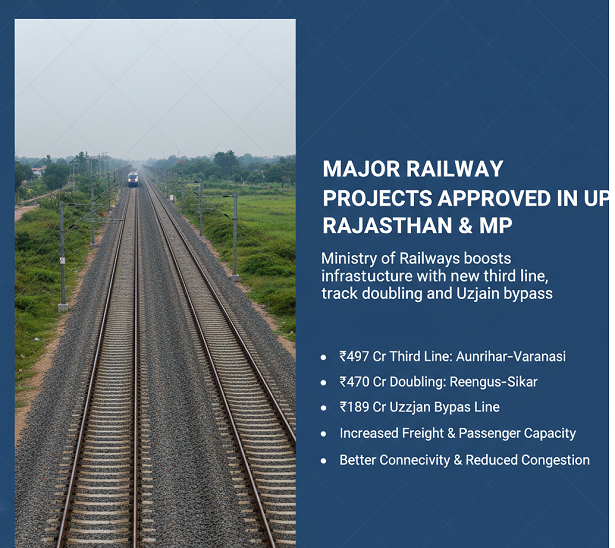
The Ministry of Railways has approved several major railway infrastructure projects across Uttar Pradesh, Rajasthan and Madhya Pradesh to strengthen India’s rail network, enhance regional connectivity and improve operational efficiency. The approved projects include construction of a third railway line, doubling of an existing rail section and development of a bypass alignment to ease congestion.
These projects aim to increase passenger safety, reduce travel time, expand freight handling capacity and ensure smoother train operations across key routes.
1️⃣ Uttar Pradesh: Third Line Between Aunrihar and Varanasi City
Under the North Eastern Railway zone, Indian Railways has sanctioned ₹497.07 crore for the construction of a 31.36 km third railway line between Aunrihar and Varanasi City.
This is a busy rail corridor handling significant passenger and freight traffic, including cement, coal, food grains, iron, steel and industrial materials.
Key Benefits:
-
More than 7 additional trains per day in both directions
-
Annual freight capacity increase of 1.99 million metric tonnes
-
Capacity utilization to rise from 87.93% to over 102%
-
Reduced congestion and improved punctuality
-
Stronger trade connectivity in Eastern Uttar Pradesh
The project will significantly support local industries and improve the overall network efficiency in the region.
2️⃣ Rajasthan: Doubling of Reengus–Sikar Rail Section
Indian Railways has approved ₹470.34 crore for doubling the 50.06 km Reengus–Sikar rail section under the North Western Railway zone.
Currently operating at 77% capacity, this section is expected to face traffic utilization of over 210% by 2029-30, making doubling essential.
Key Benefits:
-
5 additional trains daily in both directions
-
2.36 million metric tonnes annual increase in freight
-
Improved access to major religious destinations such as
-
Khatu Shyam Ji Temple
-
Salasar Balaji Temple
-
-
Boost to industrial growth and regional economy
-
Reduction in delays and better service reliability
This project will strengthen economic activity and employment opportunities in Rajasthan.
3️⃣ Madhya Pradesh: Ujjain Bypass Railway Line
Under the Western Railway zone, ₹189.04 crore has been sanctioned for the 8.60 km Ujjain Bypass line connecting Naikheri and Chintaman Ganesh.
The bypass will eliminate the need for train reversals at Ujjain Junction, significantly improving operational efficiency.
Key Benefits:
-
No train reversal at Ujjain Junction
-
Faster and smoother train movement
-
Enhanced readiness for the 2028 Simhastha Kumbh Mela
-
Better connectivity to Mahakaleshwar Jyotirlinga
-
Improved handling of heavy festival and tourism traffic
The bypass alignment will especially benefit pilgrims and tourists visiting religious destinations in Ujjain.
🚆 Brief History of Indian Railways
Indian Railways is one of the largest railway networks in the world. The first passenger train in India ran on April 16, 1853 between Mumbai and Thane during British rule.
Post-independence, Indian Railways expanded rapidly, playing a crucial role in national integration, economic growth and industrial development. Today, it operates thousands of trains daily, serving millions of passengers and transporting vast quantities of freight across the country.
With modernization initiatives, electrification drives and infrastructure expansion projects like these, Indian Railways continues to move toward becoming a modern, efficient and citizen-centric transportation system.
Conclusion
These newly approved railway projects reflect the Ministry of Railways’ commitment to sustainable and inclusive transportation development. By expanding capacity, reducing congestion and improving connectivity, Indian Railways is taking significant steps toward strengthening India's economic backbone and ensuring seamless mobility for millions of citizens.