34ºc, Sunny

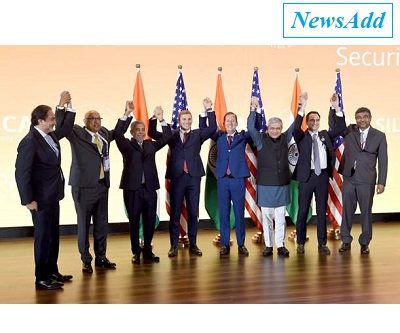
New Delhi, February 20, 2026: India formally joined the Pax Silica alliance on the fifth day of the AI Impact Summit 2026, marking a major milestone in strengthening strategic technology and semiconductor cooperation between India and the United States.
The signing ceremony brought together senior government officials from both nations, reflecting a shared commitment to securing the full technological framework powering the AI-driven global economy.
What is Pax Silica?
Pax Silica is envisioned as a strategic coalition of trusted nations committed to safeguarding the entire “Silicon Stack” — from critical minerals and semiconductor manufacturing to advanced AI systems and deployment infrastructure.
The initiative aims to:
-
>> Reduce over-concentration in global supply chains
-
>> Prevent economic coercion
-
>> Ensure democratic governance of emerging technologies
-
>> Build resilient and secure semiconductor ecosystems
Ashwini Vaishnaw: “We Are Building the Future”
Addressing the summit, Union Minister for Electronics and IT Ashwini Vaishnaw described the development as more than a formal agreement.
“We are not just hosting a summit; we are building the future.”
He emphasized the creation of new opportunities for India’s youth and highlighted the power of long-term compounded growth since independence.
Vaishnaw also underscored India’s rapid semiconductor progress:
-
>> Indian engineers are designing advanced 2-nanometer chips
-
>> The semiconductor industry is expected to require nearly 10 lakh skilled professionals
-
>> India has a massive opportunity to emerge as a global semiconductor leader
US Leaders Call It a “Roadmap for a Shared Future”
US Under Secretary for Economic Growth, Energy and Environment Jacob Helberg termed the agreement:
“Not just a document on paper, but a roadmap for a shared future.”
He stressed that economic security is national security and rejected weaponized dependency in global supply chains.
US Ambassador to India Sergio Gor described India’s entry into Pax Silica as both “strategic and essential.”
“Pax Silica will define the economic and technological order of the 21st century.”
He added that the alliance is about securing the entire silicon ecosystem — from mines extracting critical minerals to chip fabs and AI-powered data centers.
High-Level Strategic Dialogue
Following the signing ceremony, a high-level discussion was held in the presence of:
-
>> S. Krishnan, Secretary, MeitY
-
>> US Ambassador Sergio Gor
-
>> Sanjay Mehrotra, CEO, Micron Technology
-
>> Randhir Thakur, CEO & MD, Tata Electronics
The discussion focused on:
-
>> AI and semiconductor synergy
-
>> Secure and resilient supply chains
-
>> Strategic collaboration on critical minerals
-
>> Strengthening India’s position in the global tech ecosystem
S. Krishnan emphasized collaboration with “trusted partners who share common values” to secure India’s future role in global technology.
AI Revolution Is Already Here
US Ambassador Sergio Gor stressed the urgency of the transformation:
“The AI revolution is not on the horizon — it is already here.”
Micron CEO Sanjay Mehrotra highlighted the need for resilient supply chains, calling it a shared commitment to advancing AI for a better future.
Randhir Thakur described Pax Silica as a timely and strategic move, noting that the semiconductor journey has always been driven by “materials, innovation, and computing.”
A Clear Global Message
The signing of the Pax Silica agreement at the AI Impact Summit 2026 sends a strong message:
The future of artificial intelligence and advanced technologies will not be left to chance.
Instead, it will be shaped deliberately by democratic nations committed to:
-
>> Freedom
-
>> Strategic partnership
-
>> Long-term resilience
-
>> Technological sovereignty
With India strengthening its semiconductor ecosystem and deepening US collaboration, the country is positioning itself as a key architect of the next global technological order.