34ºc, Sunny

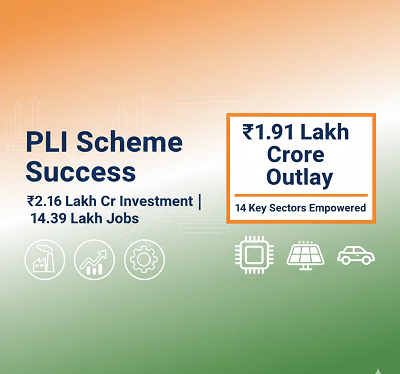
New Delhi, February 20, 2026: India’s Production Linked Incentive (PLI) Scheme, with a massive outlay of ₹1.91 lakh crore, is significantly strengthening the country’s manufacturing ecosystem and accelerating localization across 14 key sectors. Launched as a transformative reform initiative, the scheme continues to witness strong industry participation and sustained expansion in manufacturing capacity.
As of December 31, 2025, a total of 836 applications across 14 sectors have been approved, reflecting growing industry confidence in the scheme.
📊 Key Performance Highlights (as of December 31, 2025)
-
Total Approved Applications: 836
-
Total Investment: ₹2.16 lakh crore+
-
Total Production/Sales: ₹20.41 lakh crore+
-
Total Exports: ₹8.3 lakh crore+
-
Employment Generated: 14.39 lakh+ (direct and indirect)
-
Incentives Disbursed: ₹28,748 crore
These figures indicate consistent progress in attracting investments, boosting production, expanding exports, and generating large-scale employment.
🔹 Sector-Wise Impact of PLI Scheme
📱 Electronics Manufacturing & IT Hardware
India has emerged as a major manufacturing hub for mobile phones and IT hardware including laptops, tablets, servers, and all-in-one PCs. Mobile phone imports have declined by nearly 77% since FY 2020-21, with over 99% of domestic demand now met through local production. Manufacturing has expanded beyond assembly to critical components such as PCBs, batteries, camera modules, and display modules.
💊 Pharmaceuticals & Medical Devices
Domestic production of 191 bulk drugs has reduced imports worth ₹1,785 crore, increasing domestic value addition to 83.7%. Indigenous development of biosimilars, monoclonal antibodies, and new chemical entities has strengthened India’s pharmaceutical exports and supply chains. Medical devices such as imaging systems and implants are increasingly being manufactured domestically.
🚗 Automobiles & Advanced Automotive Technology
The scheme has accelerated investments in electric mobility, power electronics, and advanced safety systems. In FY 2025-26 alone, sales worth ₹32,879 crore indicate strong early momentum in technology-driven automotive manufacturing.
📡 Telecom & Networking Products
Sales of telecom and networking products have grown more than six times compared to the base year (FY 2019-20), with exports reaching ₹21,033 crore. A key milestone includes BSNL’s implementation of indigenous end-to-end 4G technology, placing India among a select group of countries with this capability.
🍲 Food Processing
Investments exceeding ₹9,200 crore have been driven by the scheme, promoting advanced technologies such as automated seafood processing systems and innovative packaging solutions.
❄️ Consumer Durables – ACs & LED Lights
Domestic manufacturing of key components like compressors, motors, copper tubes, and LED drivers has begun. The government aims to increase domestic value addition to 75–80% by 2028-29.
🧵 Textiles – MMF & Technical Textiles
The scheme is supporting a shift towards high-value man-made fiber and technical textile products, complemented by PM MITRA parks for large-scale production and better logistics.
☀️ High-Efficiency Solar PV Modules
Under Phase I and II, the scheme targets 48 GW of fully integrated solar PV manufacturing capacity with investment commitments of ₹52,942 crore, significantly reducing import dependence in the renewable energy sector.
🔎 Transformational Policy Shift
Introduced in 2020, the PLI scheme marked a major shift from traditional input-based incentives to performance-based financial incentives directly linked to incremental sales of goods manufactured in India.
This results-oriented framework promotes efficiency, transparency, capacity expansion, technology adoption, and deeper integration into global value chains.
📈 Strengthening India’s Manufacturing Future
With rising investments, expanding production capacities, increasing exports, and large-scale employment generation, the PLI scheme has emerged as a critical policy instrument in enhancing India’s manufacturing competitiveness.
By supporting key sectors, encouraging technological advancement, and strengthening domestic supply chains, the PLI scheme is playing a pivotal role in building a resilient, self-reliant, and globally competitive manufacturing ecosystem for India.