34ºc, Sunny


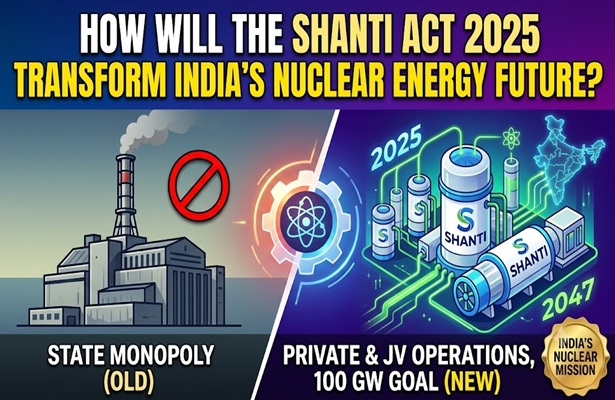
India is taking significant steps to strengthen its indigenous capabilities in the nuclear fuel cycle, aiming to enhance energy security and support long-term development goals under the Viksit Bharat 2047 vision.
The Department of Atomic Energy, through its public sector unit Uranium Corporation of India Limited, has initiated plans to expand domestic uranium mining capacity. New mining and milling projects are proposed in Sikar (Rohil) with a capacity of 2,500 tonnes per day, and in Chhattisgarh (Jajawal), both currently in different stages of statutory approval.
The Nuclear Fuel Complex continues to manufacture fuel assemblies indigenously for reactors operated by Nuclear Power Corporation of India Limited. These reactors, including Pressurized Heavy Water Reactors (PHWRs) and Boiling Water Reactors (BWRs), rely on uranium supplied domestically and through imports.
India’s research and development arm, Bhabha Atomic Research Centre, along with the Nuclear Recycle Board, is developing advanced integrated nuclear recycling facilities. Key projects include the Integrated Nuclear Recycle Plant in Tarapur and the Fast Reactor Fuel Cycle Facility in Kalpakkam.
These initiatives aim to improve spent fuel recycling, waste management, and fuel fabrication for fast reactors. The development of such infrastructure is expected to ensure a steady supply of Mixed Oxide (MOX) fuel and boost fuel production for PHWRs.
According to Jitendra Singh, Union Minister of State for Science and Technology and Atomic Energy, these measures will significantly enhance India’s self-reliance in nuclear energy and ensure sustainable fuel availability for future reactor expansion.
With these advancements, India is moving towards a more robust and self-sufficient nuclear energy ecosystem, reducing dependence on imports and strengthening its clean energy roadmap.