34ºc, Sunny

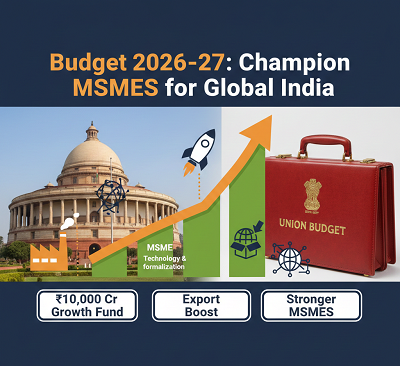
The Union Budget 2026–27, presented by Finance Minister Nirmala Sitharaman, charts a strategic vision to empower Micro, Small, and Medium Enterprises (MSMEs) and position them as growth catalysts for India’s expanding economy. With a multi-layered policy thrust, the government aims to elevate MSMEs into globally competitive champions through targeted support in equity, liquidity, professional services, and market access.
📌 MSMEs at the Heart of India’s Growth Strategy
MSMEs continue to be central to India’s economic fabric, contributing significantly to employment, manufacturing, and exports. In the Union Budget 2026–27, the government reaffirmed this role by outlining a three-pronged strategy to build robust and future-ready enterprises that can compete globally.
📍 Three-Tiered Strategy to Build Champion MSMEs
1️⃣ Equity Support – ₹10,000 Crore SME Growth Fund
A dedicated ₹10,000-crore SME Growth Fund has been announced to provide equity support to promising small and medium enterprises. This initiative aims to help high-potential MSMEs scale, innovate, and compete on the global stage.
As part of this effort, the Self-Reliant India (SRI) Fund, launched in 2021, will receive a top-up of ₹2,000 crore to continue providing risk capital access for micro-enterprises.
2️⃣ Liquidity Reforms – Expand TReDS & Credit Support
The government emphasized better liquidity access for MSMEs by strengthening the Trade Receivables Discounting System (TReDS) — an online platform that helps MSMEs convert receivables into cash quickly.
Key measures include:
• Mandatory use of TReDS for Central Public Sector Enterprise (CPSE) procurements.
• Credit guarantee support for invoice discounting.
• Integration of Government e-Marketplace (GeM) data with TReDS to boost financing.
• TReDS receivables structured as asset-backed securities to unlock deeper liquidity.
These steps aim to reduce financing delays and improve MSMEs’ working-capital cycles.
3️⃣ Professional Assistance & Compliance Support
Recognizing that scaling businesses require more than finance, the Budget proposes collaboration with professional bodies like ICAI, ICSI, and ICMAI. These institutions will develop modular courses and help establish a network of “Corporate Mitras” — trained advisors who assist MSMEs with compliance and business practices.
🌐 Opening Global Markets for Small Businesses
The Budget proposes removal of the ₹10 lakh per consignment cap on courier exports, which is expected to remove barriers in cross-border B2C e-commerce trade. This reform will enable MSMEs, artisans, and startups to reach global markets more easily.
📈 Digital Transformation & Formalization
India’s MSME sector has been rapidly formalizing with digital registrations. Since 2020, over 7 crore enterprises have registered digitally on government platforms — expanding access to benefits, compliance tools, and formal credit.
🏆 MSME Schemes & Support Structures
The Budget also continued emphasis on long-standing schemes that support entrepreneurship, credit access, and competitiveness — including credit guarantee initiatives and enterprise acceleration programs — all aimed at strengthening the MSME ecosystem across India.
📌 Conclusion
With its strong focus on equity, liquidity, professional enablement, export incentives, and market access, the Union Budget 2026–27 positions MSMEs as engines of inclusive economic growth. These policy shifts are expected to help Indian MSMEs scale beyond domestic boundaries, embrace innovation, and contribute meaningfully to job creation and export competitiveness — making them true “Champions of Global India.”