34ºc, Sunny

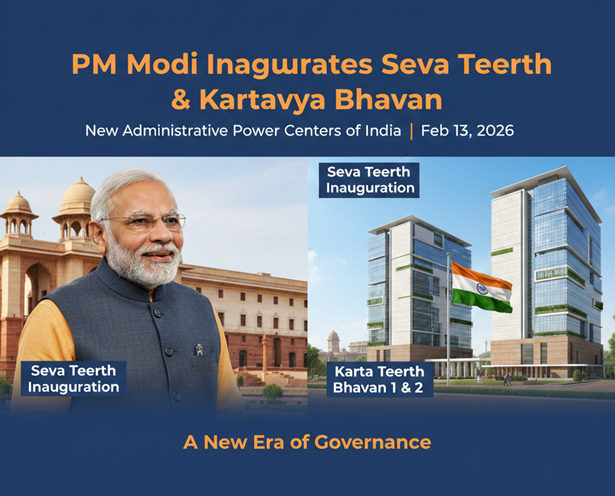
Prime Minister Narendra Modi will inaugurate the newly developed Seva Teerth complex along with Kartavya Bhavan-1 and Kartavya Bhavan-2 on February 13, 2026, in New Delhi. The ceremony will begin around 1:30 PM with the unveiling of the naming plaque of the Seva Teerth complex. Later in the evening, at approximately 6 PM, the Prime Minister will address a public gathering at the venue.
This inauguration marks a transformative milestone in India’s administrative governance structure. It reflects the government’s commitment to building a modern, efficient, integrated, and citizen-centric system aligned with the vision of a developed India.
Why the New Complex Was Needed
For decades, several key government ministries and offices operated from fragmented and aging buildings scattered across the Central Vista area. This dispersion led to operational inefficiencies, coordination challenges, increased maintenance costs, and unsuitable working environments.
The new integrated complexes aim to resolve these long-standing issues by consolidating critical administrative functions into state-of-the-art infrastructure designed for the future.
What is Seva Teerth?
The Seva Teerth complex houses some of the most crucial institutions of the Government of India, including:
-
Prime Minister’s Office (PMO)
-
National Security Council Secretariat (NSCS)
-
Cabinet Secretariat
Previously, these offices were located in different buildings. Bringing them together within a single modern complex is expected to significantly improve coordination, policy implementation, and decision-making efficiency at the highest levels of governance.
Understanding Kartavya Bhavan-1 and Kartavya Bhavan-2
Kartavya Bhavan-1 and Kartavya Bhavan-2 are newly constructed administrative buildings that accommodate several major ministries under one integrated framework. These include:
-
Ministry of Finance
-
Ministry of Defence
-
Ministry of Health and Family Welfare
-
Ministry of Corporate Affairs
-
Ministry of Education
-
Ministry of Culture
-
Ministry of Law and Justice
-
Ministry of Information and Broadcasting
-
Ministry of Agriculture and Farmers Welfare
-
Ministry of Chemicals and Fertilizers
-
Ministry of Tribal Affairs
By housing these ministries in centralized, digitally connected office spaces, the government aims to promote inter-ministerial collaboration and faster decision-making processes.
Modern Features and Sustainability Standards
Both complexes are equipped with fully digitized office environments, streamlined public interface zones, and centralized reception facilities. These features are designed to improve citizen engagement, operational transparency, and employee well-being.
Importantly, the buildings are designed according to 4-star GRIHA (Green Rating for Integrated Habitat Assessment) standards, ensuring environmental sustainability. Key features include:
-
-> Renewable energy systems
-
-> Water conservation mechanisms
-
-> Advanced waste management solutions
-
-> High-performance energy-efficient building structures
These initiatives are expected to significantly reduce environmental impact while improving operational efficiency.
Advanced Security and Smart Infrastructure
The complexes are also equipped with comprehensive security systems, including smart access control, advanced surveillance networks, and modern emergency response infrastructure. These measures ensure a secure yet accessible environment for officials, employees, and visitors.
A Step Toward Future-Ready Governance
The inauguration of Seva Teerth and Kartavya Bhavan-1 & 2 represents more than just new buildings—it symbolizes a structural reform in governance. By consolidating administrative functions into modern, sustainable, and technologically advanced facilities, the government aims to create a more responsive, transparent, and effective system.
As India continues its journey toward becoming a developed nation, this initiative stands as a landmark effort in strengthening the country’s administrative backbone.