34ºc, Sunny
 - Sunday, 9th August, 2026

 34ºc, Sunny Sunday, 9th August, 2026
Published on 04 Feb 2026, 09:15 AM by NewsAdd
For nearly a decade, artificial intelligence lived in the “test phase.” Businesses ran pilots, proofs of concept, and innovation labs—often disconnected from daily operations. In 2026, that era is ending.
Companies are no longer asking “Can AI work?”
They are asking “Can we run the business without it?”
This shift marks the Year of Truth for AI in business.
To understand why 2026 is pivotal, it helps to look at the evolution of cloud computing:
Cloud 1.0: Infrastructure migration—moving servers to the cloud
Cloud 2.0: Software-as-a-service and scalable platforms
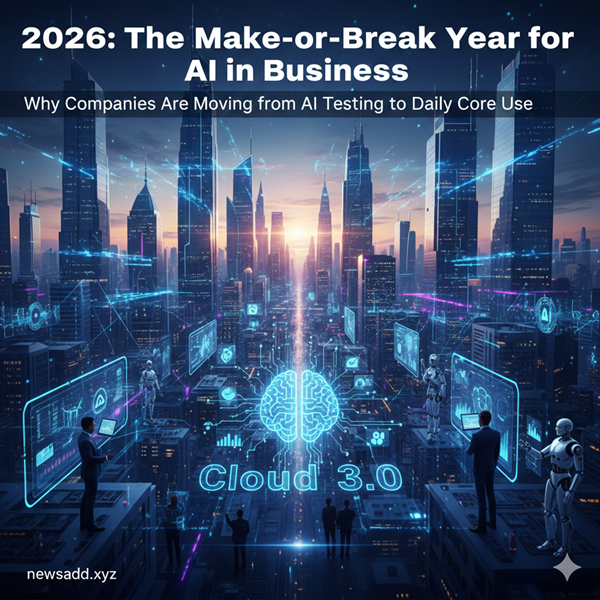
Cloud 3.0: AI-native operations where intelligence is embedded into every workflow
Cloud 3.0 is not about tools—it is about decision-making at scale. AI now sits at the center of forecasting, customer service, cybersecurity, supply chains, HR, and finance.
In 2026, AI is no longer limited to data science teams. It has become a daily co-worker across departments:
Sales teams use AI to predict deals and personalize outreach
Operations teams rely on AI for demand planning and logistics
Finance teams deploy AI for fraud detection and real-time risk analysis
Customer support is increasingly AI-first, human-assisted
Organizations that fail to integrate AI into everyday workflows are already seeing slower decision cycles and higher operating costs.
Three forces converge in 2026:
Mature AI Models: AI systems are now reliable, explainable, and scalable
Economic Pressure: Businesses must do more with fewer resources
Talent Reality: AI skills are no longer optional for competitive teams
This combination leaves companies with a stark choice:
embed AI deeply—or fall behind permanently.
The winners of 2026 are not the companies with the flashiest AI demos. They are the ones that:
Redesign workflows around AI
Train employees to collaborate with intelligent systems
Measure ROI at the process level, not the tool level
Meanwhile, companies treating AI as an “add-on” risk becoming AI tourists—aware of the technology but unable to extract real value.
Despite fears of automation, Cloud 3.0 is not about replacing people—it is about amplifying human judgment. Employees who learn to prompt, supervise, and interpret AI will define the next generation of leadership.
In 2026, the most valuable skill is not coding—it is thinking clearly with AI.
2026 is not just another year in the AI timeline. It is the point where ambition meets reality.
Businesses that make AI a core operating layer will move faster, serve better, and innovate continuously. Those that hesitate may discover that in the age of Cloud 3.0, waiting is the most expensive decision of all.