34ºc, Sunny
 - Sunday, 9th August, 2026

 34ºc, Sunny Sunday, 9th August, 2026
Published on 04 Feb 2026, 09:26 AM by NewsAdd
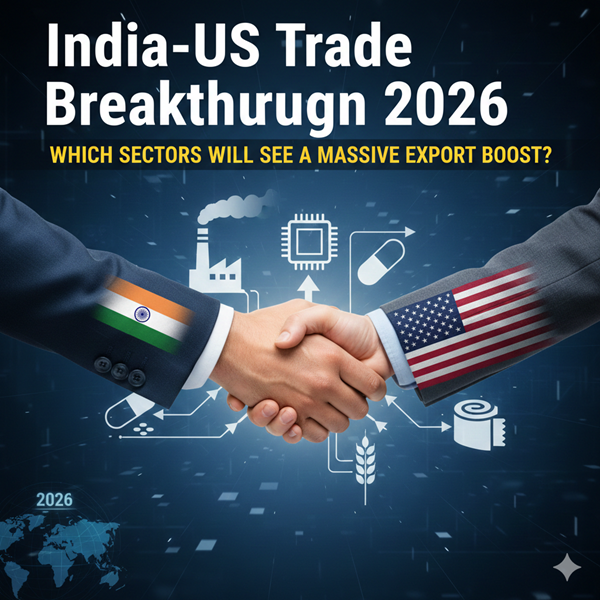
The India-US trade agreement signed in February 2026 is being seen as one of the most significant breakthroughs in bilateral economic relations in recent years. The deal focuses on reducing trade barriers, improving market access, and strengthening supply chain cooperation between the world’s largest and fastest-growing major economies.
For India, the agreement comes at a critical time—when global demand is shifting away from single-country supply chains and businesses are seeking reliable, scalable alternatives.
The United States is already one of India’s largest trading partners. The new agreement is expected to:
Simplify export procedures
Reduce tariffs on key Indian goods
Improve regulatory cooperation
Encourage long-term investment
Economists believe this will significantly improve export competitiveness for Indian businesses, especially MSMEs.
1. Manufacturing and Engineering Goods
Indian manufacturers stand to gain the most. Reduced duties and streamlined compliance will benefit:
Auto components
Industrial machinery
Electrical equipment
Defense and aerospace components
With global companies diversifying supply chains, India is positioning itself as a trusted manufacturing hub.
2. Information Technology and Digital Services
India’s IT and digital services sector is expected to see strong momentum. The agreement improves access for:
Software services
Cloud and AI-based solutions
Cybersecurity services
Fintech and enterprise platforms
This is particularly positive for startups and mid-sized tech firms looking to expand into the US market.
3. Pharmaceuticals and Healthcare
Indian pharmaceutical exports, already dominant in the US generics market, are expected to grow further due to:
Faster regulatory approvals
Better alignment on quality standards
Increased demand for affordable healthcare solutions
Medical devices and biotech services are also likely to benefit.
4. Agriculture and Processed Foods
The trade deal opens new opportunities for Indian farmers and agri-exporters, especially in:
Processed food products
Spices and grains
Organic and value-added agricultural goods
Improved logistics and compliance support will help Indian products reach US consumers more efficiently.
5. Textiles and Apparel
With shifting global sourcing patterns, Indian textile exporters may gain an edge, particularly in:
Sustainable fabrics
Home textiles
Value-added apparel
One of the most important aspects of the deal is its potential impact on small and medium enterprises. Improved market access, combined with government export-promotion schemes, could help local manufacturers and service providers integrate into global value chains.
Industry bodies expect increased employment, technology transfer, and capacity expansion at the regional level.
Despite the optimism, experts caution that Indian businesses must:
Upgrade quality and compliance standards
Invest in technology and logistics
Understand US regulatory and consumer expectations
The benefits of the trade deal will favor companies that are prepared and globally competitive.
The February 2026 trade agreement is not just about numbers—it signals deeper strategic and economic alignment between India and the United States. For India, it reinforces its position as a key player in global trade and manufacturing.
If implemented effectively, the deal could become a cornerstone of India’s export-led growth strategy over the next decade.
The India-US trade breakthrough offers a rare window of opportunity. Manufacturing, technology, healthcare, and agriculture are set to lead the export surge—but success will depend on how quickly Indian businesses adapt.
For companies ready to scale, 2026 may mark the beginning of a new global growth chapter.