34ºc, Sunny
 - Thursday, 13th August, 2026

 34ºc, Sunny Thursday, 13th August, 2026
Published on 12 Feb 2026, 12:30 AM by NewsAdd
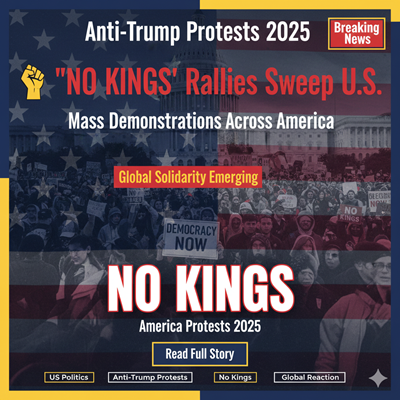
The United States is witnessing widespread demonstrations following the beginning of Donald Trump’s second presidential term in 2025. Protesters across major cities — including Washington D.C., New York, San Francisco, Chicago, and Los Angeles — have mobilized under banners reading “No Kings,” “No Fear, No Hate,” and “No ICE.”
These protests reflect growing political polarization and concerns over immigration enforcement, government restructuring, and civil liberties.
One of the central triggers behind the demonstrations is the administration’s renewed push for large-scale deportations of undocumented immigrants. Critics argue that such policies may separate families and impact immigrant communities significantly. Supporters, however, claim the measures strengthen border security and national law enforcement.
Protesters have also expressed opposition to reported reductions in certain federal government positions, raising concerns about economic stability and public services.
The slogan “No Kings” symbolizes concerns among demonstrators who believe that executive authority should remain balanced within the U.S. constitutional framework.
In June 2025, around President Trump’s birthday, coordinated protests took place in several major U.S. cities. Large crowds gathered near federal buildings, city centers, and public squares demanding policy reconsiderations and stronger protections for civil rights.
The movement has reportedly been supported by liberal advocacy groups, including organizations such as Indivisible, which promote grassroots civic engagement.
The protests have drawn international attention. Demonstrations in support of U.S. protesters were observed in:
Berlin (Germany)
Madrid (Spain)
Rome (Italy)
Toronto (Canada)
Activists abroad expressed solidarity, emphasizing shared concerns about democratic values and human rights.
If a sitting U.S. president were to be removed from office through constitutional mechanisms (such as impeachment and conviction, or other legal procedures), the Vice President would assume the presidency under U.S. law.
However, such a scenario would depend entirely on legal and constitutional processes within Congress.
Trade tariffs and economic policies are not automatically reversed if a president leaves office. Key points include:
Tariffs are often part of broader economic strategies.
Changes would depend on the new administration’s policies.
Congress and international agreements also influence trade decisions.
Some tariffs may remain in place if considered strategically important.
Therefore, global trade policies could continue unchanged unless formally revised.
A leadership transition in the United States could potentially:
Shift diplomatic tone with allies
Influence global trade negotiations
Affect immigration and defense policies
Create short-term financial market volatility
However, U.S. institutions are structured to ensure continuity of governance regardless of political shifts.
Political analysts suggest that:
Peaceful democratic dialogue should continue
Constitutional processes must be respected
Policy disagreements should be addressed through legislative channels
Civic participation, voting, and legal oversight remain central to democracy
The future direction of U.S. politics will depend largely on institutional checks and balances, public opinion, and electoral processes.
The 2025 Anti-Trump protests highlight deep divisions within American society. While supporters defend the administration’s focus on border enforcement and executive action, critics argue that civil liberties and democratic norms must remain protected.
As the political landscape evolves, the world continues to watch closely — understanding that decisions made in Washington often have global consequences.